
BENEFITS OF STUDYING IN THE U.S. FOR INTERNATIONAL STUDENTS
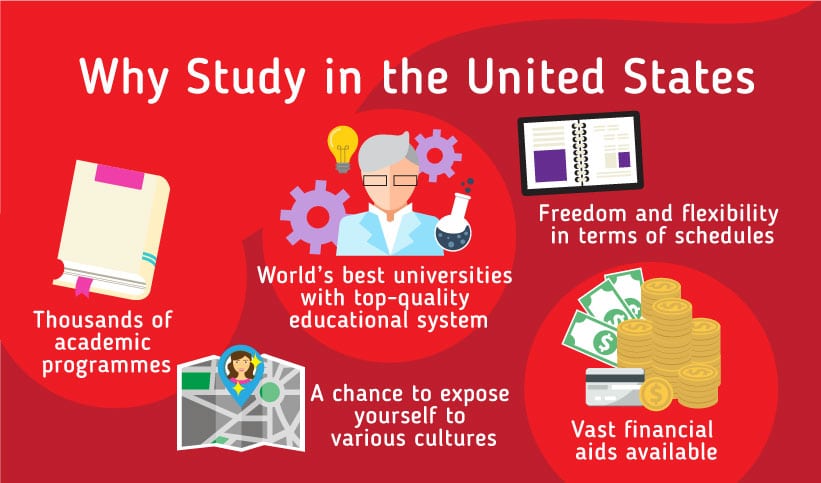
These are MIT, Harvard, Stanford, Caltech and the University of Chicago, but besides these well-known names, the US is home to hundreds of other prestigious universities and colleges. No matter in which state of the US you wish to study, you will have plenty of amazing choices to upgrade your education. The strong reputation of US universities will immediately transform you into an attractive candidate for future employers.
Higher education in the United States is known for offering a wide variety of degrees and study options to students. For this reason, there are often opportunities for students to choose a program of study that aligns with their specific interests and goals that may not be available to them in other countries.
With such a wide variety of study options available in the U.S., it can be challenging to decide which program one should pursue. In order to make this decision, it is important that students evaluate their personal and professional goals so that they can identify the degree program that is best suited to their aspirations
Whether you ultimately want to immigrate to the United States or return to your home country, earning a degree at a university in America has the potential to expand the future career opportunities available to you.
In addition to the vast array of academic and career development opportunities that international students are offered in the United States, pursuing education abroad allows for immense personal development. Studying at an American university gives students the chance to expand their global network, experience new cultures, and gain a global perspective.
Making the decision to pursue a graduate degree in the United States can open many doors in terms of personal, academic, and career development. Once you decide to take the next step toward an international education, you’ll be faced with choosing the right college or university to support you on this journey.
If you’re saying that US campus life is not the first thing that comes to your mind when thinking about studying in the US, you’re probably lying. By attending a US university, you will get the chance to experience one of the most interesting cultures, but also interact with other students from all corners of the world and become truly international.
Every young student has dreamed at least once about living in the US, and the easiest way of making your dream come true is by traveling to the US for your studies. You can live on the university campus, join sports teams, clubs and fraternities or sororities, and have all the amazing experiences you’ve been dreaming about.
After going through all these benefits, it is little wonder that so many students are choosing to study in the US. It will continue to be the top educational destination for international students and should be seriously considered by every applicant who is considering studying abroad.




Q: There are so many schools in the U.S. How do I decide which schools to apply to?
Research your options and define your priorities. Contact the Education USA advising center nearest you and browse college search engines online. Check to see if the schools your are considering are accredited.
Q: What’s the difference between a college and a university?
Colleges offer only undergraduate degrees while universities offer graduate degrees as well, but the terms are often used interchangeably.
Q: What is the academic calendar for universities in the United States?
A: The academic year usually runs from August through May with breaks for holidays. Most universities use either the semester system (two terms), the quarter system (students attend three out of four total terms), or the trimester system (three terms).
Q: What is a community college?
Community colleges are typically state-supported and provide the first two years of a four-year undergraduate degree.
Q: How can I find out if an institution is accredited?
Search the U.S. Department of Education’s Office of Post-secondary Education website to see if an institution is accredited.
Q: I want to study in the United States, but my English proficiency isn’t good enough yet. What can I do?
There are a number of programs for English language study in the United States and online, as well as local possibilities.
Q: What is the credit system in U.S. universities?
A credit is a value assigned to each course which reflects the number of hours the class will meet with the professor each week.
Q: What is a GPA?
Grade Point Average (GPA) is a numeric indicator for a student’s academic performance, calculated on a scale of 4.0.
Q: What is the U.S. grading system?
Letter grades indicate a student’s academic performance. Each letter grade has a numeric value which is used to calculate a GPA, on a scale of 4.0.
Q: How are grades determined in U.S. universities?
Grades are typically determined by quizzes, midterms, final exams, papers, projects, class attendance, and class participation.
Q: What is the difference between state and private universities?
State universities are funded by the state and are generally larger and less expensive than private universities.
Q: Are there opportunities for university exchange programs?
Contact the office responsible for international programs at your institution to ask if your school has exchange agreements with U.S. universities.
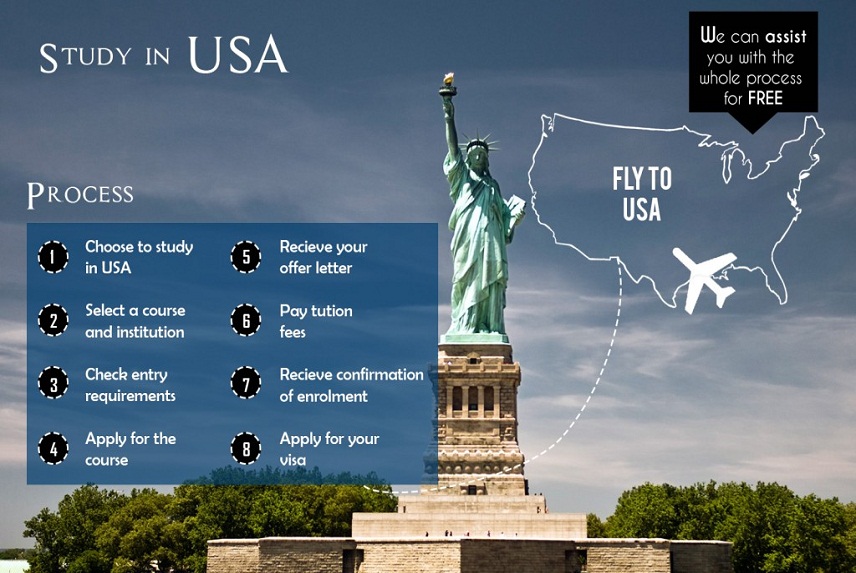
Q: What is an I-20 and how do I get it?
The Form I-20 is an official U.S. Government form, issued by a certified school, which a prospective nonimmigrant student must have in order to get an F-1 or M-1 visa. Form I-20 acts as proof-of-acceptance and contains the information necessary to pay the SEVIS I-901 fee, apply for a visa or change visa status, and be admitted into the United States. The Form I-20 has the student’s SEVIS identification number, which starts with the letter N and is followed by nine digits, on the upper righthand side directly above the barcode.
Q: I received my visa, when should I travel?
You may only enter the United States within 30 days of the beginning of the course of study stated on your I-20, regardless of when your visa was issued.
Q: Can an F-1 student work in the United States?
Full-time students on F visas may seek on-campus employment not to exceed 20 hours per week. After the first year in student status, an applicant may apply for employment off campus with authorization from USCIS. Please contact your student advisor for further information.
Benefits of Studying in the USA
-
Study at high-quality institutions. …
-
Choose from a broad range of programs. …
-
Enjoy the US student lifestyle. …
-
Get international experience for your CV. …
-
Travel and gain a new perspective on the world.
-
Improve Your Career Opportunities
-
Receive World-Class Student Support
Blog

Internships
Abroad Internship’s In a globalized world, interning and living ...
Scholarships for Abroad Study
About Scholarships Looking to study abroad but worried about ...


